


The Best Of Cordwainer Smith
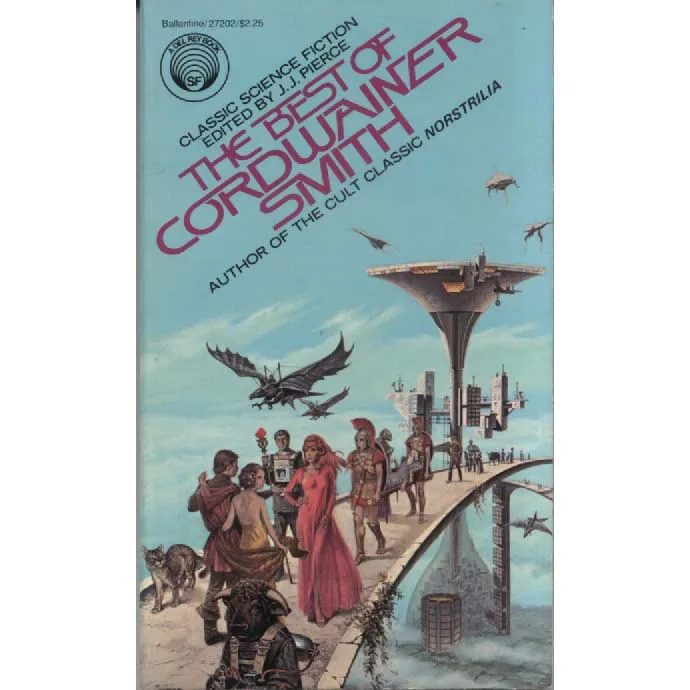
Publisher: Del Rey
Format: Paperback
ISBN: 0345272021
Cordwainer Smith wrote about a future in which humanity spreads across the stars, abolishes disease, extends life and develops technologies of almost miraculous power. Having achieved all this, it then creates new forms of suffering, establishes a government of elegant cruelty and breeds animals into human-shaped servants without rights. Technological progress has therefore worked perfectly; civilisation remains under review.
The Best of Cordwainer Smith gathers twelve stories from his vast future history, the Instrumentality of Mankind. They range across thousands of years, but belong to the same strange universe of telepathic officials, resurrected cultures, animal-derived Underpeople and starships powered by systems that sound simultaneously poetic, impossible and faintly dangerous to the soul. Smith does not so much explain this future as open a door, push the reader through it and assume somebody will eventually clarify the local customs.
In “Scanners Live in Vain,” space travel causes a pain so terrible that passengers must sleep while specially altered men endure the journey with their senses disconnected. The Scanners have sacrificed ordinary human life to make interstellar civilisation possible, only to discover that a new invention may render them unnecessary. Even in the remote future, heroic service offers no protection against technological redundancy.
“The Game of Rat and Dragon” provides one of science fiction’s more memorable solutions to an interstellar menace: telepathically linked humans and cats fighting invisible creatures in space. The cats regard themselves as mighty partners in a cosmic war, while the humans presumably remain grateful that nobody has explained the arrangement to an ordinary domestic cat and allowed it to renegotiate the contract.
The later stories explore the Rediscovery of Man, when the Instrumentality decides that centuries of safety and uniformity have made human life intolerably bland. Old languages, cultures, dangers and even diseases are reintroduced so that people can experience authentic existence again. After eliminating suffering, the authorities discover that civilisation has become dull and begin restoring selected inconveniences—a policy increasingly familiar to anyone who has used an updated piece of software.
Several of the finest tales concern the Underpeople, animals modified into human form and forced to serve their officially superior creators. “The Dead Lady of Clown Town” and “The Ballad of Lost C’mell” follow their struggle for recognition, dignity and freedom. Smith’s human-animal characters are not decorative aliens but the emotional centre of his universe, raising the awkward question of why creatures manufactured by humanity so frequently display more compassion than their manufacturers.
Elsewhere, “Mother Hitton’s Littul Kittons” reveals the grotesque protection surrounding the planet Norstrilia and its priceless immortality drug, while “A Planet Named Shayol” imagines a prison so appalling that execution begins to look like the premium accommodation package. “Alpha Ralpha Boulevard,” “Under Old Earth” and the other stories move between romance, horror, myth and satire with the serene confidence of an author who sees no reason these things should be kept in separate departments.
Behind the name Cordwainer Smith was Paul Linebarger, an academic, intelligence specialist and authority on psychological warfare whose life was nearly as unusual as his fiction. His stories carry traces of Chinese narrative, Biblical language, political theory, fairy tale and half-remembered legend. They feel less like conventional predictions of the future than ancient accounts translated from a civilisation that has not happened yet.
Edited by J. J. Pierce, the collection includes an introduction and a timeline intended to place the stories within Smith’s future history. The timeline is helpful, although readers should not expect it to make everything sensible. Cordwainer Smith’s universe becomes coherent gradually, like a dream recalled over breakfast, and some of its most appealing features remain permanently beyond the reach of ordinary administrative explanation.
This 1977 Del Rey edition is in Good condition. It shows normal evidence of previous reading but remains sound, complete and ready to transport another reader through several thousand years of improbable human history. No scanners, Underpeople or telepathically commissioned cats are included.
Sold by Crappy Old Books, where the Rediscovery of Man continues daily, usually behind a stack of 1970s paperbacks.
Keep browsing: See more Science-Fiction books Other books by Cordwainer Smith
